Irish traditions in a modern world: hurling, music and stories
The fastest sport on grass, musicians playing together in a pub, a language coming back to life, millions of emigrants: I discover Irish traditions and I link my ideas with who and which.
Relative clauses: who and which
To add information about a noun: who for a person, which for a thing or an animal. Tap the cards.
My words → tap a card: it turns over and I hear the word
Culture → living traditions, memories of exile
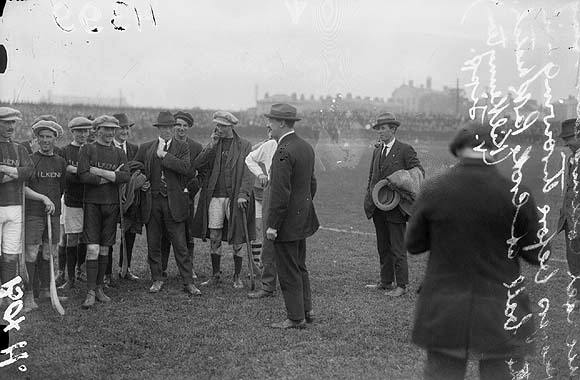
Founded in 1884, the Gaelic Athletic Association (GAA) runs the Gaelic sports: hurling, played with an ash stick (hurley) and a small ball (sliotar), and Gaelic football. The players, even the most famous ones, stay amateurs and play for their parish and their county. The final of the championship is played at Croke Park, in Dublin, in front of more than 80,000 people.
Traditional music is passed on in sessions: musicians meet in the pub with a fiddle, a tin whistle, a drum (bodhrán) or Irish bagpipes (uilleann pipes). In 1994, the show Riverdance, during Eurovision, made Irish dancing famous all over the world.
Between 1845 and 1852, a potato disease caused the Great Famine: about one million people died and more than one million emigrated, mostly to the United States. Today, tens of millions of Americans say they have Irish roots.
Did you know? → tap a card
I listen → what is hurling?
Listen. Write down how old the sport is, the names of the stick and the ball, and why the players are special. Find the relative clauses.
I watch
Video: “Why Irish Hurling Is the Fastest Game on Grass” · channel Great Big Story · watch on YouTube. The video only loads when you tap (youtube-nocookie player).
- Write down three sports words.
- Write down what hurling means for Irish people.
- Write a sentence with who or which about the video.
I watch too
Video: “History of the Irish Language” · channel Údarás na Gaeltachta (public agency) · watch on YouTube. The video only loads when you tap (youtube-nocookie player).
- Write down two moments in the history of the language.
- Find where people speak Irish every day.
The lessons in this learning journey (6)
- Traditions: what do you know about Ireland?
- Hurling and the GAA: an amateur sport for a whole nation.
- Traditional music: fiddle, tin whistle, bodhrán.
- The Irish language: from decline to revival.
- The Great Famine and emigration: a shared memory.
- Final task: present a tradition, then and now.
- “Today, I’m going to present…”
- “In the past, people…”
- “However, today…”
- “For instance, …”
- “It’s a tradition which…”
For the teacher → goals and official curriculum
- Theme 6 “Ireland” → topic: Irish traditions in modern times. 2020 theme: meeting other cultures; languages.
- Understand a presentation and a report; present a tradition.
- Grammar: relative clauses with who (people) and which (things); linking words (however, besides, for instance).
- Final task: a presentation about an Irish tradition, then and now.
Texts and materials: Photos from the National Library of Ireland; a Great Big Story report on hurling; a video by Údarás na Gaeltachta (the public agency for the Irish-speaking areas).
Theme 6 “Ireland”. Source: French national curriculum for modern languages, cycle 4, BO no. 31 of 30 July 2020 (in force in 4e in 2026-2027); matching theme of the English curriculum, BO no. 22 of 29 May 2025, which will apply in 4e from September 2027.
Fill in and choose
Match each tradition with its description
Tap an item in the first column, then its partner in the second.
Who or which?
Tap a word, then the right box.
Worksheet to fill in (paper or ENT)
The same learning journey, to print or to put on the ENT. For a PDF, choose “Save as PDF” in the print window.