Great speeches that changed history: I have a dream
On 28 August 1963, in front of 250,000 people, Martin Luther King repeated “I have a dream”. I discover the secrets of a great speech and I write my own to convince people.
Persuading an audience
A speaker repeats, insists, links ideas and talks to the audience. Tap the cards.
My words → tap a card: it turns over and I hear the word
Culture → the civil rights movement
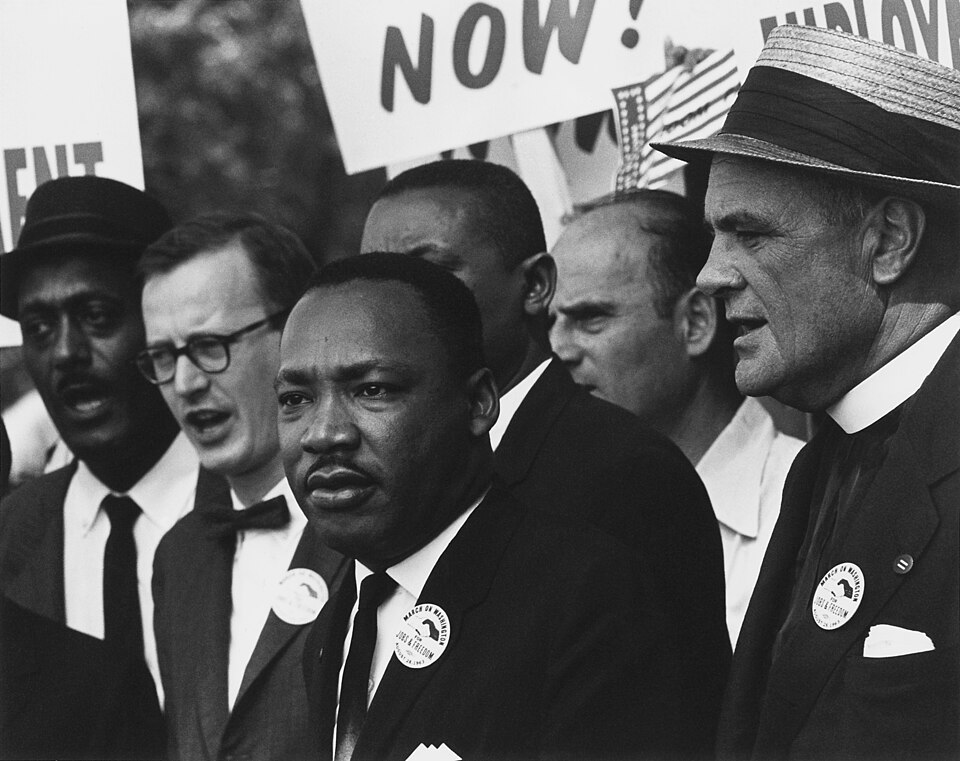
In the South of the United States, after the end of slavery (1865), laws imposed segregation: separate schools, buses and restaurants for Black and white people. In the 1950s, the civil rights movement fought peacefully for equality: the Montgomery bus boycott (1955-1956) after Rosa Parks was arrested.
On 28 August 1963, the March on Washington for Jobs and Freedom brought together about 250,000 people. In front of the Lincoln Memorial, the minister Martin Luther King improvised part of his speech and repeated “I have a dream”.
In 1964, the Civil Rights Act banned segregation, and King received the Nobel Peace Prize. He was killed on 4 April 1968 in Memphis. Since 1986, a national holiday has honoured him, on the third Monday in January.
Did you know? → tap a card
I listen → a student's speech
Listen to this student's speech. Find the repetition, the group of three, two linking words and the emphasis with do.
I watch
Video: “Martin Luther King, Jr.'s "I Have A Dream" Speech” · channel HISTORY · watch on YouTube. The video only loads when you tap (youtube-nocookie player).
- Write down the context: date, place, audience.
- Write down two techniques that make the speech powerful.
- Explain in one sentence why this speech is still famous.
The lessons in this learning journey (6)
- What makes a great speech?
- Segregation in the USA: the context.
- August 28, 1963: the March on Washington.
- Rhetoric: repetition, rhythm, images.
- Grammar: emphasis and linking words.
- Final task: my one-minute speech.
- “I am here today to talk about…”
- “What I want is…”
- “It is… that…”
- “First of all, … Moreover, …”
- “That is why…”
For the teacher → goals and official curriculum
- Theme 4 “Language and media” → topic: great speeches and great speakers who changed history. Link with theme 5 “Forms of commitment”. 2020 theme: languages.
- Understand a historical document and a video; spot the tools of rhetoric (repetition, groups of three, images).
- B1 grammar: emphasis with auxiliaries (I do believe), linking words (moreover, on the one hand / on the other hand, as a result), indirect questions.
- Final task: a one-minute speech to defend a cause.
Texts and materials: A photo of the March on Washington (National Archives); a HISTORY video about the speech; key facts about the civil rights movement.
Theme 4 “Language and media”. Source: French national curriculum for modern languages, cycle 4, BO no. 31 of 30 July 2020 (in force in 3e in 2026-2027); matching theme of the English curriculum, BO no. 22 of 29 May 2025, which will apply in 3e from September 2028.
Fill in and choose
Match each technique with an example
Tap an item in the first column, then its partner in the second.
Sort the linking words
Tap a word, then the right box.
Worksheet to fill in (paper or ENT)
The same learning journey, to print or to put on the ENT. For a PDF, choose “Save as PDF” in the print window.